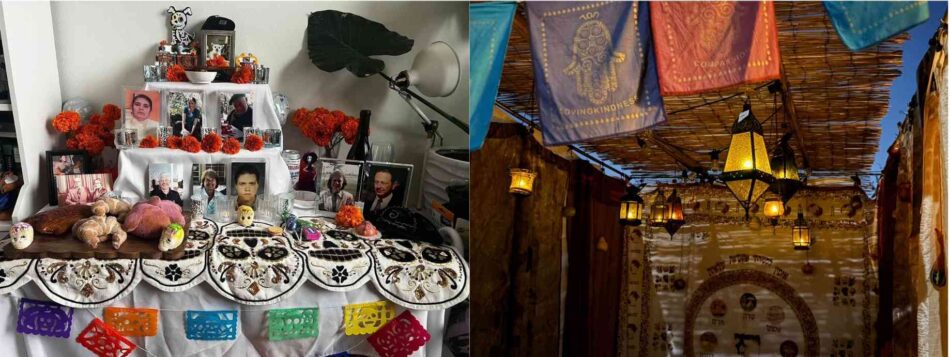
When my Mexican daughter-in-law approached her first October with us – it was during the pandemic and they were living with us – she asked could she set up an Ofrenda. My first thought was OF COURSE! What fun to learn about this tradition. Since we were also approaching Sukkot I began to make note of the two holidays shared symbols. What did it mean to have an essentially Catholic symbol in my Jewish home? Did I fully understand what I was saying?
So I asked her about the Ofrieda, what her family does about it each year. What it means to her. How it relates to her in terms of memory and family. Sure, I asked about religiously, but it had no religious connection for her.
I studied more about Sukkot. I didn’t want to lean into my ignorance and just say, “it’s ALL good.” I wanted to make informed choices so that I could explain my decisions to others in my Jewish community. Luckily for me one of my closest friends is an orthodox rabbi and I was able to receive skilled and knowledgeable teaching without judgment. Would my dear rabbi friend put up an Ofrenda, no. But I wasn’t asking him to. What I needed was to understand what Sukkot and the sukkah mean in Jewish tradition so that I could contemplate this idea using the brain God gave me. (I absolutely hate for others to tell me what they think when I am looking for data, not opinion.)
Some Key Points
Both the sukkah and the ofrenda bring our ancestors back to us for a short period of time. For Jews, the ancestors are traditionally BIBLELICAL figures and are listed as Abraham, Isaac, Jacob, Moses, Aaron, Joseph and King David. The rabbis have interpreted each of them to represent an element of Judaism, and for some rabbis, the emanations of the Divine.
For starters, those are ALL male. I have a visceral reaction to that. More research for me! I found that a number of modern Jews include female spiritual guests, Rebecca, Rachel, Leah, Miriam, Deborah, Hannah and Esther. Good! (I have to ask my rabbi friend, where’s Sarah??)
More research and I found that a number of Chabad families hang a portrait of Rebbe Menachem Mendel Schneerson in their sukkah. Their eternal spiritual leader.
My conclusion – for me, not for everyone – is that what I want to invite into my sukkah includes: core teachings of Judaism, wisdom, love, and representations of those I can not see with my eyes, but only my heart. This includes my grandparents, my parents, and my sister.
In researching the etrog and lulav I learned that there is no known origin or source. The ritual of waving them is not based on data; it is expressed as a known custom in the Torah. The best scientific basis I can find is that it is an ancient agricultural practice performed at the fall harvest in the land of Israel. The rabbis then build symbolism onto it.
Dia de Muertos is very much the same. This is not a Catholic practice brought by the Spaniards from Spain to Mexico. This is an ancient indigenous ritual absorbed by Catholicism because it was going to happen anyway.
The Ofrenda is the “alter” upon which the photos of the beloved ancestors are put and the favorite foods of your loved ones are there. Trust me, my daughter-in-law doesn’t expect the dishes to be empty in the morning. It is a practice in love and memory.
Having learned all of this, I feel quite comfortable having both. If one of my traditionally observant friends asked me, “why do you do this? Isn’t it pagan; isn’t it forbidden?” I would say, “for those who take these actions on the Pshat (simple, literal level of Torah reading) level, I would say, “For you, probably. But if you have learned enough to see the deeper teachings, then no. They teach many of the same things: honoring tradition, ancestors and our way of life. I have enough grasp of Judaism to feel confident in my observance of Sukkot, so that I don’t feel at all disquieted by the ancient ofrenda.”
If you are considering a non-Jewish tradition in your home, a “new” tradition that you’ve invented as a blend, KNOW what you are doing.
Please remember Aesop’s fables: LOOK BEFORE YOU LEAP.
Learn and then learn again before you teach.