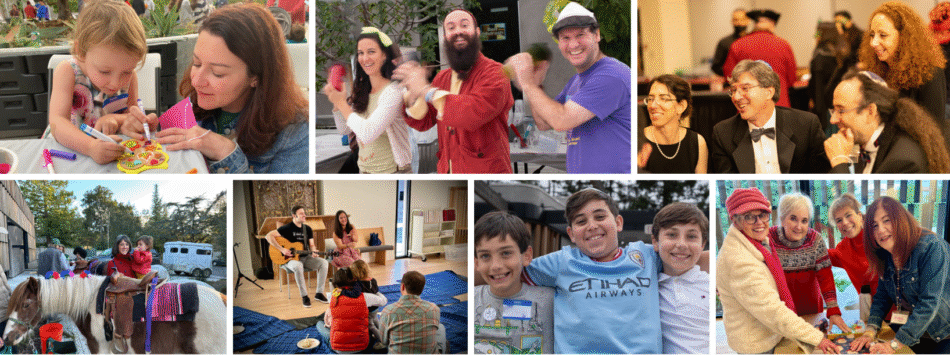
(Photo from Kol Emeth, Palo Alto)
As the years of bad news grind on and the daily news tears at our souls it is easy to be paralyzed by despair. But Judaism teaches us not to surrender. The word I read most frequently after October 7 was RESILIENT. Get back up and forge on.
One effective way to do that is to help others. Take action! Don’t accept the acts of cruelty.
Today Rabbi Booth and the other clergy from Kol Emeth sent an email to their congregation. I want to share it with you.
Immigration: A Letter From Clergy
We, like so many, have been heartbroken by the images and stories emerging from our country in recent days. Whatever our political beliefs, nobody wants to see our country divided with confrontation, violence, and people living in fear. We know that events have left many of us shaken, struggling to make sense of suffering that feels overwhelming and close to home. We write in order to pause, to reflect, and to name the values that guide us as Jews as we seek to respond with integrity and care.
Judaism teaches that every human being is created b’tzelem Elohim—in the image of God. From this flows the inherent dignity and infinite worth of every person. Our tradition insists that systems of authority and power be exercised with fairness, restraint, and accountability, and that fear and cruelty never become normalized. Justice, tzedek, is not abstract for us; it is meant to be lived.
We are deeply shaped by the Jewish experience of living among many peoples and cultures. Our community values the ability to gather in prayer and fellowship with people of different backgrounds, identities, and life stories. Diversity within our community is not something to be feared. It is something to be honored.
Jewish wisdom also teaches that the use of force must be constrained and guided by humility. The rabbis consistently emphasize pikuach nefesh—the sanctity of life—and the obligation to pursue peace wherever possible. De-escalation and careful judgment are not signs of weakness; they are expressions of strength.
Our tradition is especially sensitive to the vulnerability of those who live with uncertainty and fear. The Torah repeats again and again the command to care for the ger—the stranger—because we know, in our bones, what it means to be strangers ourselves. Many in our community carry family stories of displacement, refuge, and rebuilding. These memories are not merely historical; they are ethical obligations.
Judaism also teaches that when we witness wrongdoing or suffering, we may not turn away. Nonviolence, moral courage, and love are central Jewish responses to injustice. As Pirkei Avot reminds us, we are not required to complete the work, but neither are we free to desist from it.
In the weeks ahead, we look forward to learning more about organizations that provide direct support to vulnerable populations and others in need, and to identifying meaningful opportunities for volunteerism and chesed—acts of lovingkindness. We are grateful to those who have offered to help lead this effort and welcome community participation.
These are unsettling times, and it is natural to feel sorrow, worry, and confusion. As a community, we can respond not from fear or visceral anger, but from our true gift: the Jewish values handed down to us. At Kol Emeth, we affirm that we stand against cruelty and dehumanization, and we stand for compassion, dignity, and love.
Rabbi David Booth
Rabbi Sarah Graff
Morat Derekh Sarah Miller